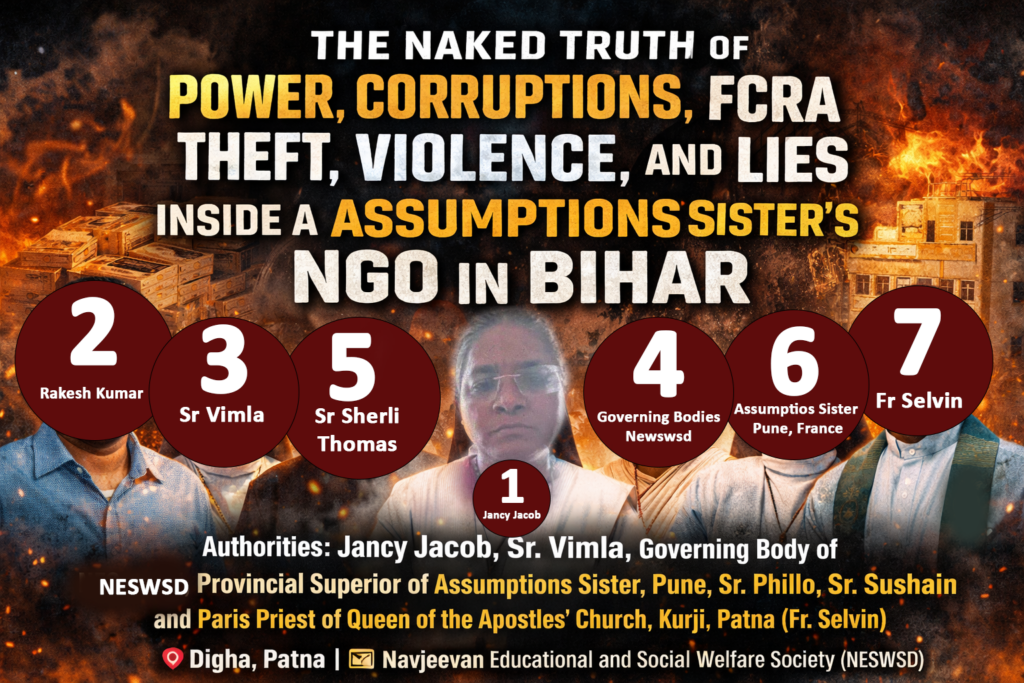
On 11 June 2025, an unexpected early-morning call came while I was still asleep. It was not a normal or respectful hour for such a serious discussion. The call came from those connected with the Assumption Sisters, and on the line was Fr. Selvin Xavier SJ, Parish Priest of Kurji Church, Patna. At a time when the Digital Team Leader, Program Support Officer, and the entire team were already under extreme mental pressure due to police involvement and false allegations, this sudden early call itself felt disturbing and inappropriate.
During the conversation, Fr. Selvin repeatedly spoke about “nyay” (justice), saying “Woh bol raha hai nyay kariye aur aap bol rahe hai nyay kariye.” However, the form of justice he proposed was deeply troubling. He suggested that both sides should sign papers and that the Digital Team Leader, Program Support Officer, and their team must give a promise that there would be no police action, no media exposure, and no court proceedings. In effect, we were being asked to surrender all lawful and constitutional remedies in the name of peace.
We calmly reminded him of the facts. In the May 2025, we had been called numbers of times to the police station due to complaints filed by Rakesh Kumar and Jancy Jacob. Despite this pressure, we did not file any counter-complaint, we did not approach the media, and we did not go to court. We asked a simple and honest question: after all this restraint, why was there still no trust in us, and why were we being asked to sign on a blank paper? If the other side was truly serious and honest, they could have written and signed first with clear terms, and we would have done the same. Instead, we were asked to sign and write on a blank paper, which raised serious concerns of trust and safety.
Because of this lack of clarity and trust, we refused to sign. Even after refusing, we still did nothing, no police complaint, no media statement, no legal case. What makes this situation more disturbing is that a police complaint had already been filed in the May by Jancy Jacob and Rakesh Kumar, and Fr. Selvin Xavier SJ, was fully aware of this. He also knew about the false allegations, the repeated police station visits, and the mental and professional damage caused to our team. Yet, despite knowing all this, he chose to intervene in a manner that appeared to defend and support Rakesh Kumar and Jancy Jacob, while asking only our side to remain silent and compromise.
It is deeply concerning that a parish priest, after knowing the full background, would ask individuals already facing police pressure to avoid the police, courts, and media, and to sign blank papers. Donation to a church or proximity to religious institutions cannot become a moral shield for questionable actions. Justice cannot be selective, private, or forced, and it cannot depend on money, influence, or position.
Throughout this entire period, the Digital Team Leader, Program Support Officer, and their team acted with restraint and dignity. We did not retaliate, we did not misuse any platform, and we did not provoke unrest. Our only expectation was lawful, transparent, and equal justice. Justice should not arrive as an early-morning shock, should not be demanded while someone is half-asleep, and should never require surrendering constitutional rights. True justice stands in daylight, guided by law, fairness, and accountability not by pressure or silence.
Pointable lines: Does being connected to a church or wearing a religious title automatically make a person beyond question, even when serious allegations and past criminal involvement are known? Just because someone gives donations to the church, does that grant them moral immunity or the right to be protected at any cost? If a person has been involved in criminal activities or has pending cases, is the duty of a priest to shield them, or to stand firmly with truth and justice? And when the accused happens to be a “Sister” or a regular donor, does accountability suddenly become optional?
Is faith meant to cleanse wrongdoing, or to cover it? Is donation an act of devotion, or does it quietly become a price paid for silence and protection? When pressure is placed only on the weaker side to compromise, to remain silent, and to abandon police, court, and media, can that truly be called reconciliation? Or is it control disguised as peace? If justice is the real intention, why is transparency feared so deeply?
When religious authority chooses influence over fairness, does it still remain moral authority? When a priest stands closer to power than to truth, who is really being served? Does a shepherd protect the flock, or negotiate with the wolf because the wolf feeds the institution? And when blank papers are suggested instead of written truth, is that wisdom or fear of what written truth might expose?
Can a fox forever remain hidden under the wool of a sheep, or does truth, sooner or later, tear the disguise apart? If faith cannot stand with honesty, accountability, and law, then what exactly is being protected religion, reputation, or wrongdoing itself? These are not accusations; they are questions. And questions, when unanswered, speak louder than any defense.
Some questions to Fr. Selvin Xavier SJ (Paris Priest of Kurji)
- Fr. Selvin, why did you choose to intervene in this matter after a police complaint had already been filed, instead of encouraging a lawful and transparent process from the beginning?
- Why did you ask the Digital Team Leader and Program Support Officer to promise “no police, no media, no court” when they had already shown restraint and had not taken any legal action?
- On what moral or ethical basis did you suggest signing or writing on a blank paper, knowing the serious risks and misuse such documents can lead to?
- Why was trust demanded only from one side, while the complainant side was not first asked to withdraw allegations or give written assurance?
- If justice was your true intention, why were clear written terms and equal safeguards for both sides not ensured before asking for signatures?
- Why did your intervention appear to defend and support Rakesh Kumar and Jancy Jacob, even after being informed about the police pressure, false allegations, and harm caused to the team?
- Does donation to the church or association with a religious institution influence how neutrality and fairness are exercised in such conflicts?
- Why were constitutional rights such as access to police, courts, and media presented as obstacles rather than protections?
- As a parish priest, do you believe your role is to manage silence and damage control, or to stand firmly with truth, justice, and accountability?
- Looking back, do you believe asking for compromise under pressure truly reflected justice, or did it risk protecting wrongdoing at the cost of truth?