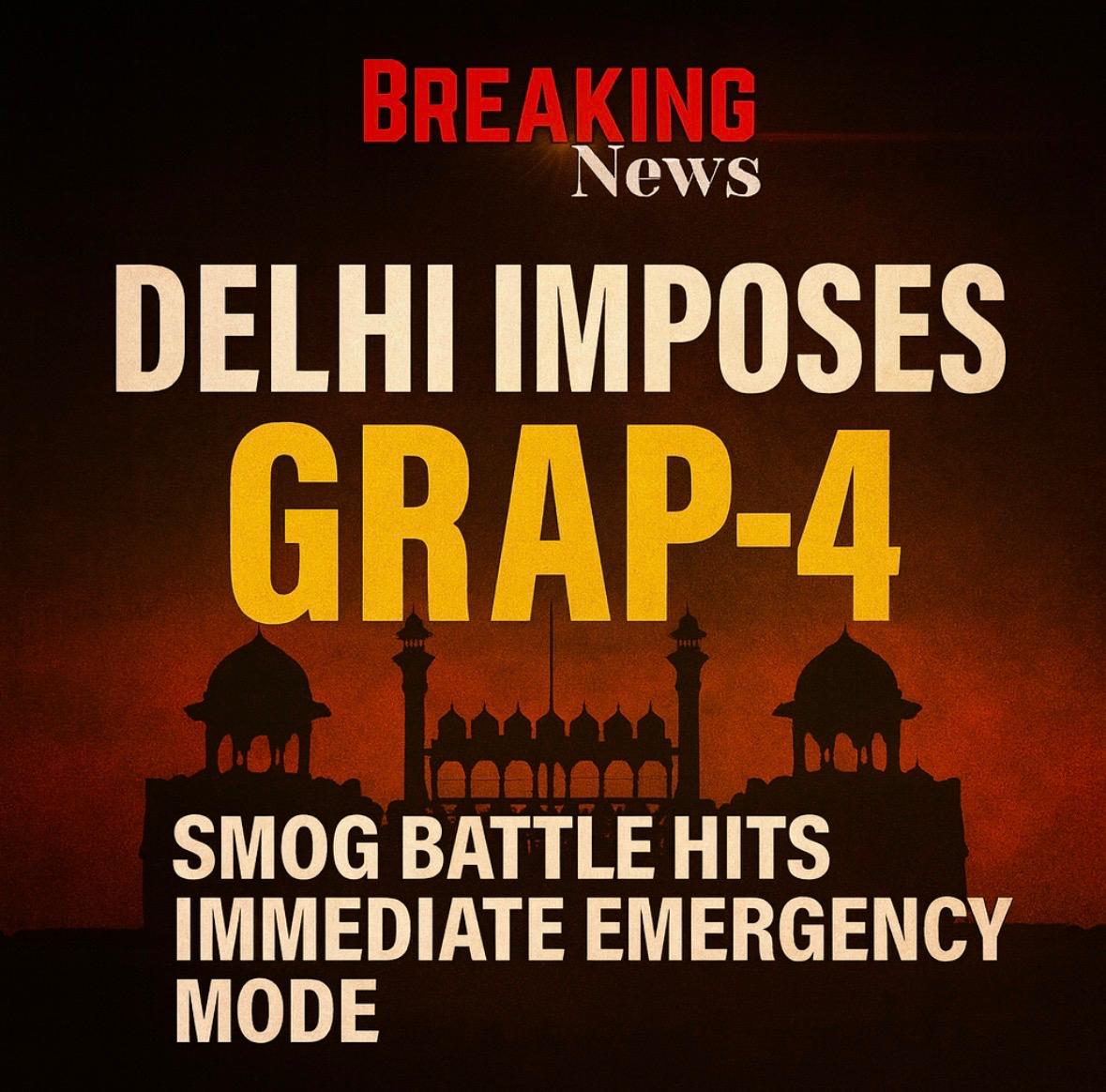
Air pollution in Delhi and the National Capital Region (NCR) has worsened sharply, pushing authorities to take emergency measures. With the Air Quality Index (AQI) touching 441 by 6 PM, the situation has entered the ‘Severe+’ category, prompting the Commission for Air Quality Management (CAQM) to impose GRAP Stage-4 with immediate effect.
The decision comes amid rising health concerns as poor air quality continues to choke the capital, making breathing increasingly difficult for residents.
AQI 441: A Serious Health Threat: An AQI above 400 is considered extremely dangerous. At this level:
- Even healthy people may experience breathing difficulties
- Children, elderly citizens, and patients with asthma or heart diseases are at high risk
- Prolonged exposure can lead to serious respiratory and cardiovascular problems
- Doctors have advised people to avoid outdoor activities and take necessary precautions.
GRAP (Graded Response Action Plan) is implemented in stages depending on pollution levels. Stage-4 is the strictest level, enforced only during extreme pollution emergencies.
According to CAQM, slow wind speed, stagnant atmospheric conditions, and poor dispersion of pollutants have led to the rapid deterioration of air quality, making GRAP-4 unavoidable.
Key Restrictions Under GRAP-4: Following the enforcement of GRAP-4, several strict measures have come into force across Delhi-NCR:
- Construction Activities Halted
- All non-essential construction and demolition work has been stopped
- Roadwork, building projects, and excavation activities are suspended
- Vehicle Restrictions
- Entry of BS-III petrol and BS-IV diesel vehicles is banned
- Only essential services are exempted
- Polluting industries have been ordered to shut down temporarily
- Use of diesel generators is prohibited, except for emergency services
- Schools may shift to online classes
- Government and private offices are advised to promote work-from-home
Experts point to multiple factors behind the worsening air quality:
- Crop residue burning in neighbouring states
- Vehicular emissions
- Dust from construction activities
- Seasonal weather patterns, including low temperatures and weak winds
Every winter, Delhi-NCR faces a similar crisis, but this year the pollution spike has been particularly severe.
Authorities have urged residents to:
- Avoid unnecessary travel
- Use public transport where possible
- Wear masks outdoors
- Keep children and elderly indoors as much as possible
Weather forecasts suggest that wind conditions may remain unfavourable over the next few days. If pollution levels do not improve, restrictions could be extended or further tightened.
The current situation highlights the urgent need for long-term solutions to tackle Delhi’s air pollution problem. Clean air is not a privilege it is a basic right.