

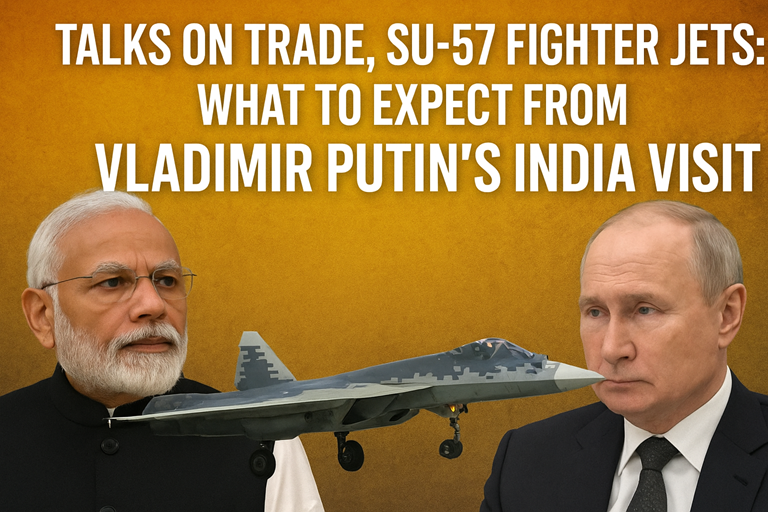
Russian President Vladimir Putin’s arrival in New Delhi for a two-day state visit comes at a time when global geopolitics is in flux, major power rivalries are sharpening, and economic alignments are being re-drawn. For India, the visit is less about ceremonial tradition and more about strategic continuity anchoring a partnership that has weathered ideological shifts, sanctions regimes, and changing global power equations.
Trade: The Unfinished Agenda: Despite political warmth, the India–Russia trade relationship remains uneven. The sharp rise in India’s import of discounted Russian oil has widened India’s trade deficit to uncomfortable levels. New Delhi’s push for greater market access for agricultural goods, marine exports, processed foods, and pharmaceuticals is not merely commercial it is strategic. A durable partnership cannot stand on asymmetric economic foundations.
The long-pending Free Trade Agreement with the Eurasian Economic Union offers a potential corrective, but only if both sides show urgency. The proposed mobility agreement for Indian workers is a welcome development, signaling Moscow’s readiness to expand ties beyond traditional defense cooperation.
Defense: Old Pillar, New Expectations: Defense cooperation remains the bedrock of India–Russia relations, but it is also the area under the highest scrutiny as India diversifies arms purchases and strengthens indigenous capabilities.
New Delhi’s reported interest in additional S-400 systems following their successful use in recent operations and the possible exploration of the more advanced S-500 platform underline Russia’s continuing relevance to India’s air defense architecture. The discussions on the Su-57 stealth fighter and potential production transfer are particularly significant. For India, technology access matters more than hardware; for Russia, offering deeper cooperation is a route to safeguarding its most dependable defense partnership.
Yet, this cooperation must be weighed against India’s long-term strategic objective: reducing dependency and strengthening self-reliance under Aatmanirbhar Bharat. Any new acquisition must align with this trajectory.
Energy and Fertilisers: Silent but Strategic: Russia’s offer of additional discounts on crude oil and India’s consistent import of Russian fertilizers reflect a mutually beneficial economic logic. As global markets face uncertainty, India’s pursuit of affordable energy and agricultural inputs is practical, not ideological.
If anything, these sectors illustrate the adaptability of the partnership: as the global order reconfigures, both nations continue to find common ground.
Diplomacy and Regional Security: Beyond trade and defense, the visit is expected to reaffirm long-standing cooperation in counter-terrorism and regional security. India’s consistent stand emphasizing “dialogue and diplomacy” on the Russia–Ukraine conflict is likely to find mention, even as New Delhi maintains its strategic autonomy.
The opening of new Indian consulates in Kazan and soon in Yekaterinburg signals Delhi’s intent to deepen its diplomatic footprint across Russia—an often overlooked but vital component of long-term engagement.
A Partnership Tested, Yet Resilient: As Putin receives a ceremonial welcome at Rashtrapati Bhavan and holds delegation-level talks with Prime Minister Narendra Modi, the symbolism will be unmistakable: despite the turbulence of global politics, India and Russia continue to find space for collaboration.
But symbolism alone cannot sustain a partnership. The relationship must adapt, modernize, and confront hard economic realities. India’s expectations are clear balanced trade, credible technology transfer, and respect for its growing strategic autonomy. Russia’s expectations are equally evident reliable political support and continued defense cooperation.
The success of this visit will depend on how effectively both nations align these expectations.
Key Takeaways from Vladimir Putin’s India Visit
1. Strategic Significance
- Visit reaffirms India–Russia ties as one of the most stable bilateral partnerships despite shifting global geopolitics.
- Signals continuity in India’s multi-alignment and strategic autonomy approach.
2. Trade & Economic Cooperation
- India seeks to address a large trade deficit driven by imports of oil, fertilisers, and defence equipment.
- Push for increased Indian exports: marine products, agricultural goods, processed foods, consumer goods, and pharmaceuticals.
- FTA negotiations with the Eurasian Economic Union (EAEU) have advanced; both sides may accelerate finalisation.
- Mobility Agreement (skilled and semi-skilled workers) expected to be a major deliverable.
3. Defence & Security Cooperation
- Defence remains the central pillar of the relationship.
- India reportedly evaluating:
- Additional S-400 air defence systems (based on recent operational performance).
- Possible exploration of S-500 platform.
- Discussions on advanced fighter aircraft: Su-57 fifth-generation stealth fighter with tech transfer and possible phased production in India. Potential offer of Su-75 Checkmate.
- Pending S-400 deliveries likely addressed.
- Long-standing counter-terrorism cooperation (since 2002) continues as a consistent agenda item.
4. Energy & Resource Security
- Russia may offer additional crude oil discounts amid shifting global market conditions.
- India continues annual imports of 3–5 million tonnes of Russian fertilisers—critical for agricultural security.
5. Diplomatic Expansion
- New Indian consulate in Kazan operational; another in Yekaterinburg to open soon.
- Symbolises deeper Indian outreach across Russia beyond major cities.
6. Regional & Global Issues
- India expected to reiterate its position on the Russia–Ukraine conflict—advocacy for “dialogue and diplomacy”.
- Broader discussions on Eurasian security, Indo-Pacific concerns, and emerging global alignments.
7. Expected Agreements
- Pacts in: Trade & economic cooperation, Healthcare, Media collaboration and Mobility & workforce movement.
8. Putin’s Official Schedule (5 December)
- Ceremonial welcome at Rashtrapati Bhavan.
- Tribute at Rajghat.
- Delegation-level talks with PM Modi.
- Joint press statement.
- Business engagement with FICCI.
- Meeting with Honorable President Droupadi Murmu.