A detailed timeline • Achievements • Governance reforms • Bihar’s transformation
1. Early Life & Background — From a Small Town to National Politics
- Born: 1951 in Bihar.
- Grew up in a socio-political environment and became active in youth politics.
- 1970s: Joined the JP Movement (Jayaprakash Narayan Movement), which shaped his political ideology.
- This phase laid the foundation for his future career in governance and reforms.
2. Early Political Journey — Entry into Legislature & Central Politics
| Year | Milestone |
| 1985 | Elected MLA for the first time from Bihar. |
| 1989 | Elected to Lok Sabha (MP) — beginning of national-level presence. |
| 1990 | Became Union Minister of State for Agriculture. |
| 1998–1999 | Union Minister for Railways — credited with railway computerisation and reforms. |
| 2001–2004 | Continued holding important central ministries such as Surface Transport. |
These years gave him administrative experience, national exposure, and an understanding of governance challenges.
3. Return to Bihar — The Fight to Become Chief Minister
2000 — First CM Term (Only 7 Days)
- Took oath as CM but lost majority and resigned within a week.
- This set the stage for his later comeback.
4. 2005 — The Turning Point: Beginning of “Sushasan (Good Governance)”
In November 2005, Nitish Kumar became the Chief Minister again, this time with a solid mandate.
This marked the end of the era commonly called “Jungle Raj” a period associated with high crime, caste violence, and administrative collapse and the beginning of large-scale reforms.
5. Major Achievements & Reforms (2005–2010 and beyond)
A. Law & Order Reform
Often cited as his biggest achievement:
- Massive crackdown on criminals.
- Fast-track courts created for quick trials.
- Policing system strengthened.
- Marked decline in kidnapping and violent crime.
B. Infrastructure Transformation
- Construction of thousands of kilometers of roads and bridges.
- Improved connectivity between rural and urban areas.
- Expansion of electricity availability.
C. Education Initiatives
- Mukhyamantri Balika Cycle Yojana (2006): Free bicycles for schoolgirls dramatically increased school attendance.
- Improved recruitment of teachers.
- Mid-day meal expansion and school infrastructure upgrade.
D. Women & Social Welfare
- Introduction of liquor ban (2016) to reduce domestic violence and alcoholism (controversial but widely recognised).
- Promotion of women’s self-help groups.
- Welfare schemes for children, elderly, and economically weaker sections.
E. Governance Modernisation
- Wide use of ICT, e-governance, digital record systems.
- Public service delivery reforms (certificates, permits, land documents).
- More transparent government functioning.
Together, these reforms contributed to Bihar’s improving image, governance, and growth indicators.
6. Timeline — Nitish Kumar as Chief Minister of Bihar
| 1st Term | 2000 | Lasted only 7 days. |
| 2nd Term | 2005- 2010 | Start of “Good Governance” era. |
| 3rd Term | 2010- 2014 | Deepened reforms; strong mandate. |
| 4th Term | 2015 | After Grand Alliance victory. |
| 5th Term | 2015– 2017 | Resigned & changed alliance. |
| 6th Term | 2017- 2020 | Returned to NDA. |
| 7th Term | 2020- 2022 | Pandemic-era administration. |
| 8th Term | 2022- 2024 | Switched back to Grand Alliance. |
| 9th Term | 2024- 2025 | Continued governance. |
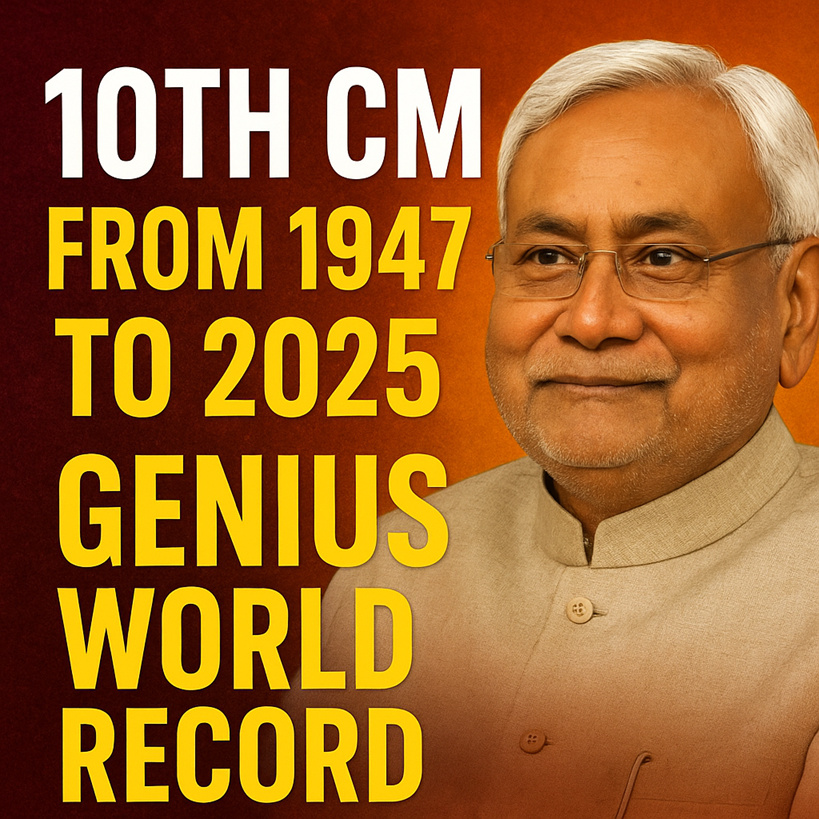
| 10th Term | 2025 | Became CM again, completing 10 swearing-in’s — one of India’s most frequent CM terms in history. |
His political survival, alliance calculations, and adaptability gave him the nickname:
“Chanakya of Bihar Politics.”
7. Bihar’s Transformation — “Jungle Raj to Mangal Raj”
The phrase refers to the comparison between two eras:
Jungle Raj era (1990s):
- High crime rate
- Caste violence
- Kidnapping for ransom
- Administrative collapse
- Poor roads and public services
Mangal Raj / Good Governance era (2005 onward):
- Stronger law & order
- Roads, bridges, electricity expansion
- Rise in school enrollment (especially girls)
- Social welfare programmes
- Digital governance
- Improved economic activity
While challenges remain (unemployment, industrialization, migration), Nitish Kumar undeniably brought structural improvements and restored public confidence in governance.
8. Criticism & Challenges, even with many achievements, his tenure has faced criticism:
- Slow industrial growth
- Continued migration of youth
- Frequent alliance shifts
- Liquor ban’s mixed economic impact
- Persistent poverty in some regions
But despite these, his reforms significantly changed Bihar’s administrative and social environment.
9. Nitish Kumar’s legacy rests on:
- Restoring law and order
- Transforming governance
- Improving education and infrastructure
- Bringing Bihar out of political and administrative darkness
He is seen as: One of the most influential, longest-serving, and impactful leaders in Bihar’s modern history.