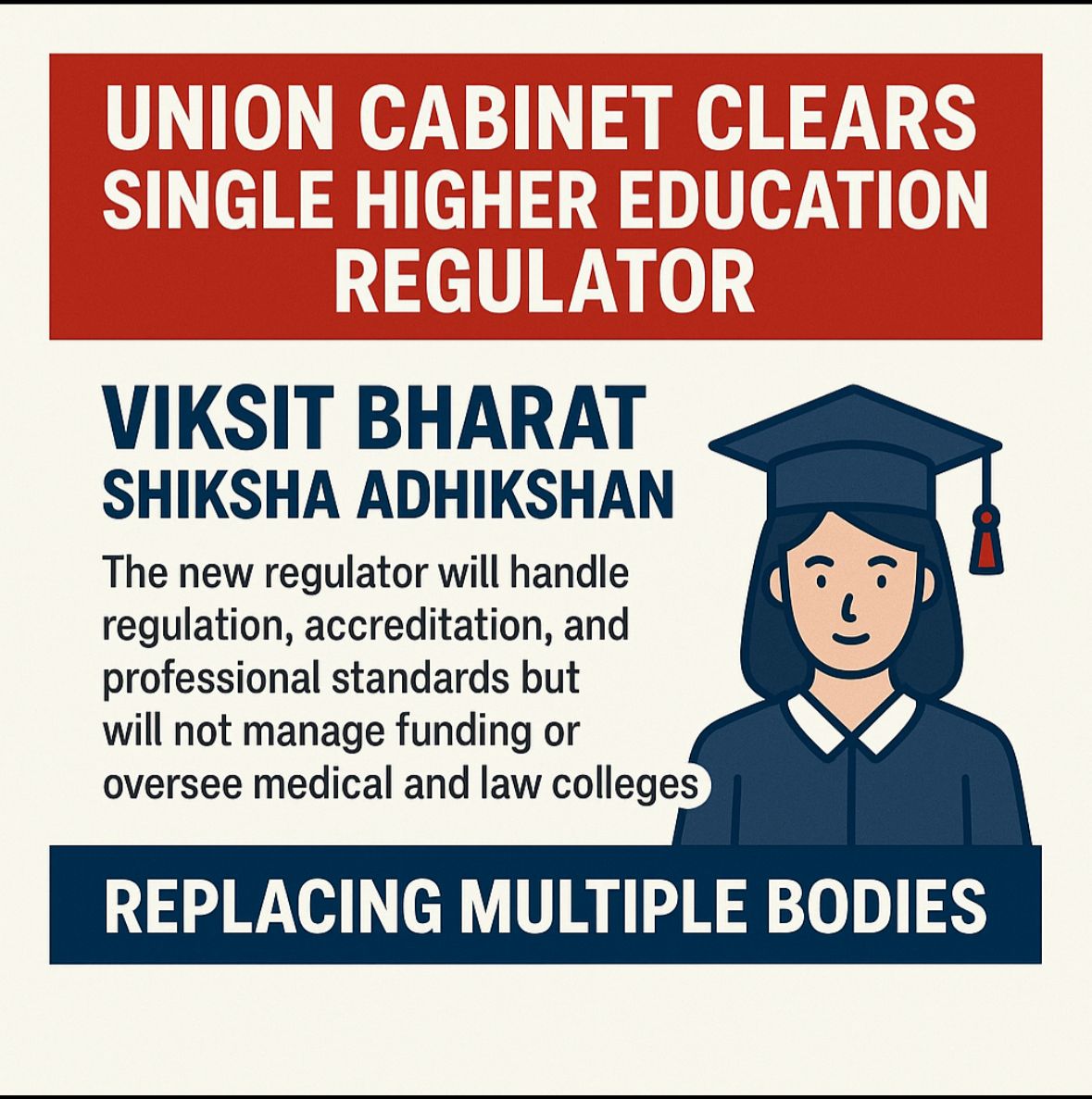
In a major reform aimed at simplifying India’s higher education system, the Union Cabinet has approved a bill to create a single higher education regulator, replacing multiple existing bodies. The move is in line with the vision of the National Education Policy (NEP) 2020 and is expected to bring clarity, efficiency, and transparency to the sector.
What is the new regulator: The proposed body will be called Viksit Bharat Shiksha Adhikshan. Earlier, this legislation was known as the Higher Education Commission of India (HECI) Bill. With the Cabinet’s approval, the government has now moved ahead with the new name and structure.
Which bodies will it replace- At present, higher education in India is regulated by different organisations:
- University Grants Commission (UGC) for non-technical higher education
- All India Council for Technical Education (AICTE) for technical education
- National Council for Teacher Education (NCTE) for teacher education
The new regulator will replace all three, bringing them under one unified framework.
What will the new body do- The Viksit Bharat Shiksha Adhikshan will have three key responsibilities:
- Regulation of higher education institutions
- Accreditation to ensure quality and accountability
- Setting professional and academic standards
However, it is important to note what the new body will not do. It will not handle funding, which will remain with the concerned administrative ministry. It will also not oversee medical and law colleges, which will continue to be governed by their respective professional councils.
Why is this change important- The NEP 2020 clearly highlighted the need for reform in higher education regulation. It stated that the existing system requires a complete overhaul to help the sector grow and perform better. According to the policy, functions such as regulation, accreditation, funding, and academic standard-setting should be handled by separate, independent, and empowered bodies. The new bill follows this principle by keeping funding and professional education outside the scope of the regulator.
How did this reform take shape- Efforts to establish a single higher education regulator gained momentum after Dharmendra Pradhan took charge as Union Education Minister in July 2021. Since then, the government has been working towards implementing the NEP 2020’s vision of a streamlined and learner-focused education system.
What does it mean for students and institutions- For students, this reform is expected to bring greater transparency, uniform standards, and better-quality assurance across institutions. For colleges and universities, a single regulator may reduce confusion caused by overlapping rules and approvals, making governance simpler and more efficient.
Overall, the approval of the Viksit Bharat Shiksha Adhikshan Bill marks a significant step towards transforming India’s higher education landscape and aligning it with the long-term goals of a developed and knowledge-driven India.